Tuesday, April 12, 2016

Unexpected Things Happen When You Abandon Your Workout Routine

It happens to the best of us: You get injured, find yourself working around the clock or are otherwise forced to put exercise on the back burner for a while. And when the holidays roll around, you’re also provided an incentive to eat and drink and skip your workouts until January. But a day or two can easily stretch into weeks or even months, and you’re right back to square one. In technical terms, you’ve become “deconditioned.” In fact, 25 to 35 percent of adult exercisers quit working out within two to five months of starting, according to the American College of Sports Medicine (ACSM). How quickly your fitness level declines depends on several factors. Some may surprise you.

1. Cardiovascular Fitness Starts to Tank After One Week

Aerobic fitness is defined as the ability of the body to transport and utilize oxygen from your blood in your muscles. This measure, also known as VO2 max, decreases after as few as one to two weeks of inactivity, says Danielle Weis, doctor of physical therapy with Spring Forward Physical Therapy in New York City. “The functional capacity of the heart also decreases. After three to four weeks of bed rest, your resting heart rate increases by four to 15 beats, and blood volume decreases by five percent in 24 hours and 20 percent in two weeks.”

2. You Lose Cardiovascular Fitness More Slowly If You’re a Seasoned Exerciser

If you’re new to fitness and recently started working out (less than six months), you’ll lose fitness faster than someone who’s been exercising a year or longer, says Brad Thomas, M.D., orthopedic surgeon and UCLA chief of sports medicine. “You’ll lose up to 40 percent of your cardio fitness, but your fitness VO2 max will still be higher than someone who’s never exercised,” he says. For example, you take two people: one who’s exercised regularly for two years and the other for only two months. If both stop working out, they will both lose all their gains quickly — by about six weeks. “But the well-trained athlete will lose about 40 percent and then plateau,” says Thomas. So trained athletes lose less fitness than sedentary people who’ve only recently started exercising.

3. Flexibility Loss Occurs Quickly

You lose the benefits of flexibility quickly if you take any substantial time off from stretching, says Michele Olson, professor of exercise science at Auburn University in Montgomery, Alabama. “After a bout of flexibility exercise, the muscles and tendons begin to retract to their typical resting length — particularly if you sit during your commute regularly and/or sit at a desk at your job.” Olson notes that you’ll notice a loss of flexibility in as few as three days, with even more pronounced changes occurring at the two-week mark. “Stretching should be done at least three times a week — if not daily,” she says.

4. Strength Starts to Diminish After Two Weeks

When you quit strength training, changes in your muscles begin to occur within days, says exercise physiologist Michelle Olson. “Muscle, when not receiving its regular challenge, will start to lose protein, which is absorbed into your circulation and excreted via urination. Small but meaningful loss in muscle protein (the building block of the contractile units for each muscle fiber) can begin to occur in 72 hours.” Noticeable changes when attempting to lift your usual amount of weight show up in two to three weeks, adds Olson. And as with cardiovascular fitness, long-term exercisers will see a slower muscle loss than those new to exercise, says Dr. Brad Thomas.

5. You Lose Power Faster Than You Lose Strength

Power, defined as strength times distance over a period of time (e.g., how quickly you can hoist a weight or dash across the street to make the light), fades faster than strength, says physical therapist Danielle Weis. “Strength losses first occur due to a change in the nerve’s impulses to muscle fibers, shortly followed by actual muscle wasting.” During muscle wasting, protein breaks down at a faster rate and protein synthesis (building) drops. The time it takes for you to return to your original fitness level depends on the reason you stopped exercising in the first place — whether due to illness or simply lack of time.

6. Fitness Levels Decline Faster When You’re Sick

Someone who’s healthy and takes a break from exercise loses muscle mass and cardiovascular fitness more slowly than a person who stops exercising due to an illness or injury. The latter will lose fitness levels twice as fast, says Dr. Brad Thomas. The stress of an illness or injury takes a greater toll on the body than simply taking a break when you’re healthy. Whether you’re an athlete or recreational exerciser, if you’ve taken a few weeks off from your routine, your level of deconditioning will be pretty low, says physical therapist Danielle Weis. “If you are recovering from a fracture, surgery or have been on bed rest, it can take up to and longer than 12 to 24 months to fully recover.”

7. Maintenance Is Easier Than You Think

If you’re planning to take time off from your workout routine, keep in mind that staying in shape isn’t an all-or-nothing proposition. In fact, you can maintain your fitness levels in a surprisingly small amount of time, says Dr. Brad Thomas. “In order to maintain both aerobic and strength levels, you need just 20 minutes of high-intensity interval training (HIIT) twice a week.” Thomas cautions that the work effort must be truly high-intensity, at between 80 and 90 percent of your maximum heart rate.

8. Aging Affects Fitness Loss

You lose strength and overall fitness twice as quickly as you age, says Dr. Brad Thomas. “It’s largely due to hormone levels. As we age, we have lower levels of human growth hormone (HGH), which makes it harder to recover.” We also lose our ability to handle stress and recover from the resulting stress hormones, such as cortisol. As we get older, this same mechanism results in greater fatigue after a workout. Older athletes take longer to recover from workouts in general, according to several studies, including a 2008 article published in the Journal of Aging and Physical Activity.

9. It Takes Three Weeks to Gain Back One Week Off

After a period of lying around, your nervous system loses its ability to fire up as it did before you took time off, says Irv Rubenstein, exercise physiologist and founder of STEPS, a science-based fitness facility in Nashville, Tennessee. That’s due to the fact that you lose the neural stimuli that enables you to lift heavy objects with the same amount of effort. “When you return to lifting, you may be able to lift the same weights, but you will be working above your normal capacity, which could put tissue at risk. It will take a greater effort to do what you used to do and will require more rest between sets and days in order to recover. ”A novice who’s taken time off during the holidays will need to start from scratch. The athlete or experienced lifter can start back to where they were in early November and give it a month to get back to speed.

What Do YOU Think?

What do you do when you don’t have time for your regular workout? Have you ever been sidelined by an injury? How long did you have to stop working out? What was your recovery process like? If you stopped because of your busy schedule, how long did it take you to recover?


Sunday, April 10, 2016

She survived her first driving-while-texting accident – but not her second

This has been a flaming hot button of mine for a long time and it angers me that more isn't done to bring this subject under a better understanding. All kinds of companies seem to do their utmost to enable the issue without employing the kinds of safeguards needed to help. Education is not enough to instruct and explain the dangers, because I see regular misuse of the technology on a daily basis.

It is more than sad that the resulting tragedy seems to be a regular occurrence in the news, and the people who should be paying attention seem to be saying, "This won't happen to me"... and yet, here we are again with another grim reminder.

She survived her first driving-while-texting accident – but not her second


Read more here: http://www.charlotteobserver.com/news/nation-world/national/article71022122.html#storylink=cpy

Bike Crashes, Divine Intervention, and the Nature of Evil

An Open Letter to Larry Taunton
BY MICHAEL SHERMER

They say “God works in mysterious ways.” Does He intervene in the lives of some people and not others based on the quality of the prayers of their friends and family? In this week’s eSkeptic, in an open letter to Larry Taunton, Michael Shermer questions Taunton‘s belief that his recovery from a bicycle accident was due to divine intervention prompted by the many prayers of family and friends.
=======================================================

On my cycling training ride today, which is when I do most of my deepest thinking (unless I’m riding with the Young Turks who like to go fast, in which case there’s no blood in my brain and I’m doing no thinking at all), I had an idea for a debate we could do on theodicy, the nature of good and evil, why bad things happen to good people, and why things happen at all (chance, law, or design), starting with your near-fatal bike crash, recovery, and the credit for it. As your friend and occasional debate partner, and especially as a fellow serious cyclist who has had a few run-ins with cars in my days on the open roads of America, this got my attention and got me thinking…

In your twitter feed following your bike crash and recovery, you thanked God for the “miraculous” nature of your return to health and acknowledged those who prayed for you. Of course you are grateful for being alive given the alternative (although in your case, given your Christian beliefs about the soul and the afterlife, the alternative isn’t such a bad thing, right?). But how do you know it was God and prayer that enabled your recovery? Assuming your tweets were not of the generic gratitude for being alive sort, along the lines of what anyone might mean when they say “thank god for such a beautiful day” or “thank heavens our company didn’t go under this year,” your gratitudinal gestures indicate that you believe divine intervention is what saved you. To wit: 

My physicians say that I am a walking miracle. If this is so, it is due to the many prayers offered on my behalf to a mighty God. 

And from your office twitter feed: 

Update: Oct 10 Larry was hit head-on by a car while cycling. He's at home now recovering. He's grateful for your prayers & glad to be alive. 

Good news: Larry’s condition has been downgraded. He's been moved from ICU to Trauma. He values your prayers as he recovers. 

Larry‘s body is broken, but not his spirit. He trusts in God’s sovereign plan and is humbled by your many prayers on his behalf. 

Pray for Larry. He was hit by car cycling and is in intensive care in serious but stable condition. 

And from your friends: 

@LarryTaunton May God comfort and fully restore you, our General in the faith. I agree your greatest days are ahead, hence the attack. 

Again, I do not doubt your appreciativeness to your friends and well-wishers for saying nice things—we all like that, of course—but if you also attribute your recovery, at least in part, to divine intervention, then a few questions come to mind. […]

Read the full article:


Surprising Signs You’re Not Getting Enough Water

This article is from INH Health Watch.

There is one substance more important for good health than any other; it’s water.
Consider this: Your brain and heart are 73% water. Your lungs about 83%; your skin, 64%; muscles and kidneys, 79%. Even bones are 31% water.

Of course, thirst is the first sign you need more water. But there are other common symptoms you may be suffering from, ones you’d never associate with dehydration.


(Tink's comment: In all my years of backpacking and mountaineering, I learned that the average person gives off about a liter of water a day in the simple act of respiration. So remember, you are causing your body to dehydrate through the simple act of just breathing. The climate, the ambient temperature, altitude, and activity level all have an effect on the magnitude your respiration gives off. Therefore, you need to take in at least this much water, just to compensate for it. This is your 'break even' number.)

Dehydration upsets the entire body’s ability to function. Running low on water is like letting your car run out on gas. It eventually shuts down. It can lead to blood clots, seizures, and chronic health conditions. Even mild dehydration can have adverse effects. So it’s important to identify dehydration early.
Here are seven surprising signs you need more water:

1). Sleepiness. Water allows your brain to focus. When there isn’t enough, it shuts down by inducing sleep.

2). Hunger. Many people confuse hunger with thirst. If you’ve just eaten but still feel hungry, reach for a glass of water instead of a snack. Dehydration can also cause cravings for sweets. The liver uses water to release glycogen. This gives you energy. If you are short on water and your liver can’t release glycogen, your body looks to sweets for energy.

3). Blood pressure spikes. Episodes of high blood pressure can be caused by dehydration. Your blood may be thickening. This causes your pressure to go up. If you get a surprisingly high blood pressure reading, drink a glass or two of water. Wait an hour. Then check your blood pressure again.

4). Headaches. Your brain sits in a protective fluid sack. If this sack becomes dehydrated, the brain bumps against the skull. This causes a headache. People who habitually don’t drink enough water can experience chronic headaches.

5). Constipation. If you are dehydrated, the large intestine extracts water from your food. This causes stools to become compacted.


6). Bad breath. Saliva has antibacterial properties. But dehydration prevents your body from making enough of it. This leads to flourishing mouth bacteria and bad breath.

7). Dry Skin. This could mean your body is robbing your skin of water to keep other body functions operating. It’s a widespread myth you need eight glasses of water a day. You may actually need more. But there’s a catch. A man needs about twelve 8-ounce cups of water per day. A woman needs about nine cups. If they sweat or exercise a lot, they need more.

But a lot of our hydration needs are met by the water in foods we eat… Especially fruits and vegetables. Many are 90% water. This makes it tricky to gauge fluid intake. One great way to track your hydration is with a free iPhone app called Ozmo.

Doctors often advise that you know you’re dehydrated if your urine is dark or bright yellow. But this can be problematic for people taking supplements. Vitamins B and C can cause darker urine even when you drink plenty of water.

The best advice: Be conscious of drinking plenty of water throughout the day. Keep a glass or bottle handy. And eat plenty of water-rich fruits and vegetables. That way you’ll never run short of the world’s most important nutrient.


Friday, April 08, 2016

All drugs are poisons, and that’s OK

There are a number of aphorisms that one imbibes over many years of medical education, especially in medical school. Some are useful; some are not; but some stick with you for reasons that even you can’t figure out. For example, I still remember my first day of medical school over 30 (!) years ago. It started with an introductory session beginning at 8 AM that lasted about an hour, an “orientation,” if you will, after which classes began as normal. During this orientation, members of the medical school leadership, such as deans and the chairs of certain major departments, got a chance to speak to the brand new medical students, introduce themselves, and impart a little wisdom, such as they saw it. Not surprisingly, there was the usual “rah rah” about how lucky we were to be attending the University of Michigan Medical School, how we were the elite, the 170 or so students accepted out of over 3,000 applicants, the usual blather. I imagine that it’s the same sort of thing they do now in “white coat ceremonies,” but back then there was no real ceremony, and, as far as I’m concerned, it was good that there wasn’t. I personally find white coat ceremonies that nearly every medical school now indulges in when a new class enters the school to be just a little too reminiscent of rituals welcoming new initiates into a religion for my liking.
Be that as it may, one thing I remember from the thankfully nonexistent pomp and circumstance I experienced starting medical school. The first was one of the professors (I forget which one) telling us that, ten years after we graduated, we will have forgotten at least 75% of what we learned, but what we remembered would be the “right” 25% for our patients. He also told us that at 50% of what we learned would be out of date; so we would have to learn to learn.

Another aphorism that I distinctly remember from later in my medical school experience was delivered on the very first day of my pharmacology class. Within the first five minutes the professor told us that all medications were poisons. They all interfere with normal cellular processes in some way. The ones we use as physicians just interfere with cellular processes in a way that can be beneficial in disease, and, quoting Paracelsus, he noted that the dose makes the poison.
Read the full article:

Wednesday, April 06, 2016

10 Places your Expectations vs Reality


Unfortunately, the image we have in our mind is not we can expect to experience when we get there.

Expectations vs Reality


Sunday, April 03, 2016

Exercise Moves That Lead to Better Sex

Nothing ruins an evening quite like a lackluster bedroom experience. Maybe it didn’t last long enough, or maybe you had to take a breather after your arms almost gave out. Unfortunately, these are just a few of the many ways your performance can quickly go downhill. For starters, there’s the undeniable relationship between alcohol and sex. A few drinks might put you in the mood, but those same beverages could also make it nearly impossible to get busy. Studies, such as this 2008 one from the University of Washington, have shown alcohol consumption can make it significantly more difficult for men to achieve an erection. Even guys who manage to make it that far could still be in for a struggle. A 2004 study from The University of Missouri — St. Louis revealed 11% of folks who drank alcohol had difficulty reaching orgasm, including men.
Aside from alcohol, consider the way it challenges your strength. Most of the positions you’re assuming in the bedroom are completely different from the ones you use in your everyday life, so you’re forced to stress muscles that might not otherwise get much work. While cutting back on drinks might seem like a tough sell, this is one problem that’s pretty easy to solve. All you have to do is start working those body parts you’ve neglecting. These five moves will help give you the strength you need to take your sex life from good to great.

1. Planks

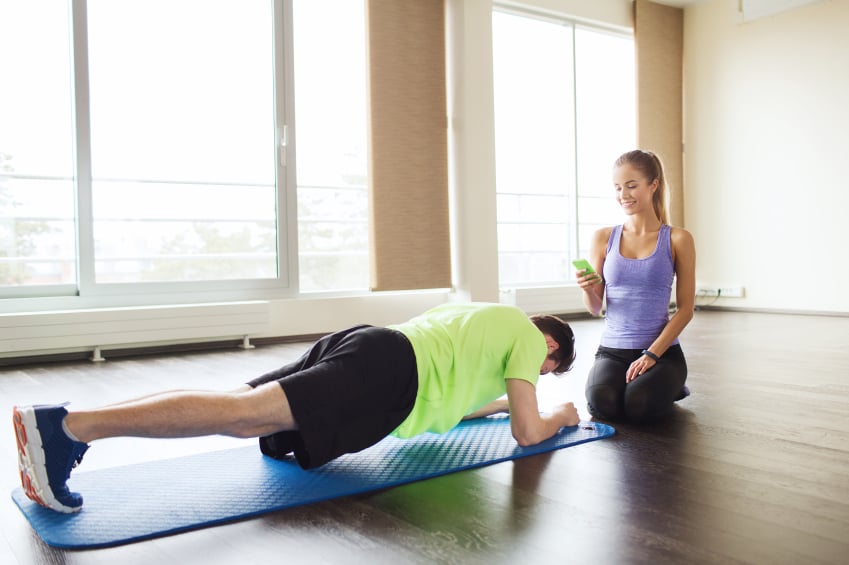
doing planks at the gym
Sex is a lot more fun than hitting the gym, but it’s also a pretty good way to work up a sweat. For overall strength and stamina, focusing on your core is critical. One glance at this move shows exactly why. It forces you to support yourself with your arms while keeping your body aligned, similar to many positions where you’re on top. According to Livestrong, building strength in your midsection will also boost your ability to thrust and reduces the risk of throwing out your back.
To perform this move, really a hold, get yourself into a push-up position on the floor. Bend your elbows at a 90-degree angle and position your shoulders directly above your elbows, resting your weight on your forearms. Keeping your core tight and your body in a straight line, hold the position for as long as possible. Men’s Fitness recommended a few variations to try once you’re able to hold the plank for more than 2 minutes.

2. Leg Swings

leg swings
It’s easy to get bored between the sheets if you’re always relying on the same two positions. Even if you have grand plans for creative ways to move, tight hips will keep you from exploring anything new. Sadly, everyone who works a desk job is basically guaranteed to have limited flexibility here. Men’s Health explained sitting in this position for extended periods of time prevents your hip flexors from enjoying a full range of motion and can actually shorten them.
The good news is you can undo that tightness with a simple move that doesn’t require any special equipment. There are two types of leg swings, but the motion is basically the same for both. To perform forward leg swings, use your right arm to help you balance against a wall or a chair. Slightly bend your right knee to raise your right leg off the ground. Swing your right leg forward as far as possible, then swiftly backwards as far as possible. New York Road Runners demonstrated the proper technique. After you finish the move with your right leg, switch to your left.
For side swings, you’ll position yourself to face the wall. This time, swing your leg in the same fluid motion out to the side, then in front of your body and out to the other side. You want to swing as far as possible, but don’t strain yourself. You may find it takes a few repetitions to reach your full range of motion, so be patient.

3. Bowing Push-Ups

push ups
No matter how daring you intend to be, it’s pretty likely you spend a fair amount of time in missionary position. Even if your partner likes the feel of having your weight on top, nobody wants to get completely squished. B.J. Gaddour, CSCS and Men’s Health fitness advisor, told the publication, “You need strong arms and shoulders to hold yourself up the entire time.” One of the best ways to target both of these areas is a move Gaddour calls the bowing push-up.
To perform this move, get yourself into a push-up position. Keeping your elbows close to your body, lower yourself until your chest is just a few inches above the floor. In one motion, drop your hips towards the floor as your squeeze your glutes, and push your arms straight, lifting your head towards the ceiling. Sound vaguely familiar? It’s really just a variation of a standard yoga sequence.

4. Kegels

man laying on a mat outside
You’ve probably heard of kegels, and you probably think they’re a women’s exercise. Surprisingly, this move is just as effective for men as it is for the ladies. Named after Dr. Arnold Kegel, this exercise is a great way to strengthen your pelvic floor muscles. Why is that important for sexual performance? Everyday Health explained tightening these muscles prior to orgasm can help you last longer.
The easiest way to introduce yourself to kegals is actually in the restroom. The next time you go to the bathroom, try to stop and start the flow of urination a few times to become familiar with the muscles. Once you get the hang of it, you can perform this exercise anytime, anywhere. Lifehack suggested performing a few sets of 10 to 15 repetitions where you hold the contraction for five seconds.

5. Hip Lifts

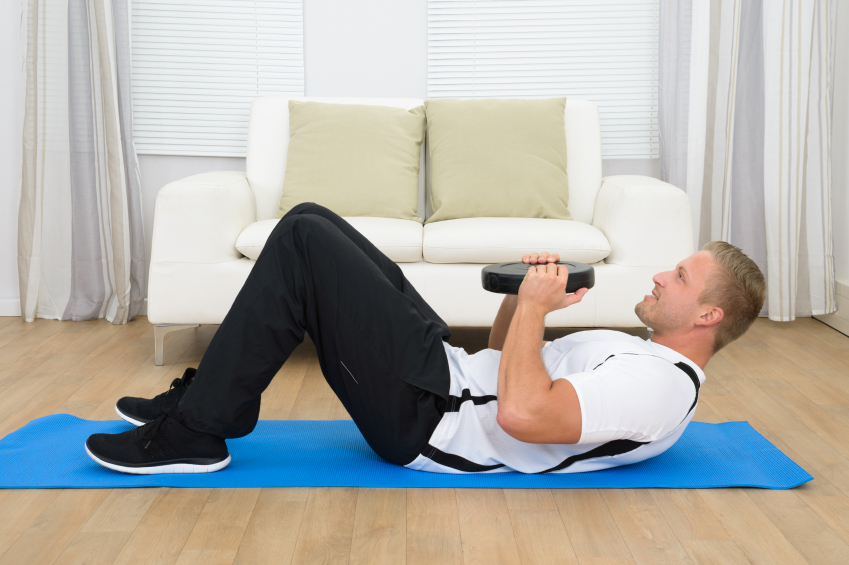
man using a weight to perform hip lifts
No matter what position you prefer, you need strong glutes and hamstrings to adequately lift and thrust. Even if you’re on the bottom, your partner shouldn’t have to do all the work. Make sure you’re doing your part by incorporating hip lifts into your workout. Start by lying on the ground with your knees bent and your feel flat on the floor. Hold a weight securely against your lap. Keeping your core tight, push your hips up until your torso forms a straight line, then carefully lower yourself back to the starting position. AskMen recommended three sets of 15 repetitions, starting with a 10-pound weight. As you get better, you can reach for something heavier.
Men’s Health said inadequate strength in your glutes can lead to lower back problems and contribute to a posture that makes your gut appear larger, so this move is also practical. And because this muscle group is so large, strengthening it is a smart way to increase the overall number of calories you burn.

Friday, April 01, 2016

Discipline = Bridge Between Goals + Accomplishments

From Brian Josnson's "The Optimizer"


“You will never change your life until you change something you do daily. That means developing great habits. Discipline is the bridge between goals and accomplishments, and that bridge must be crossed every day. Over time that daily crossing becomes a habit. And ultimately, people do not decide their future; they decide their habits and their habits decide their future. 

"What are you doing daily that needs to change? What needs doing? Maybe more importantly, what needs undoing? Advice columnist Abigail Van Buren quipped, ‘A bad habit never goes away by itself. It’s always an undo-it-yourself project.’ What are you willing to change doing today in order to change what you will be doing tomorrow?”

The quote is by John C. Maxwell (a well-known motivational expert and business advisor) from: The 15 Invaluable Laws of Growth

 The above paragraph is from the chapter on the Law of Consistency. Maxwell repeats this phrase a number of times throughout the book: “You will never change your life until you change something you do daily.”

And I LOVE (!) the image of discipline as the bridge between goals and accomplishments. Remember: We need to cross it daily.

Reminds me of my interview with Navy SEAL Commander, Mark Divine. As we discussed his mental toughness classic Unbeatable Mind (see Notes), he told me that SEALs need to earn their trident every day. The training and testing to become a SEAL is the most grueling on the planet.

But that’s only the beginning. Then they need to cross the bridge every.single.day.

The same is true for us. So, let’s get specific here. What do you need to change in your daily routine?

What’s the #1 thing you need to START doing that, as you build the habit of doing it DAILY will have the most positive impact on your life?

#1 +1 = ________________________

And, what’s the #1 thing you need to STOP doing that, as you completely (!) eliminate it from your life, will have the most positive impact on your life?

#1 -1 = _________________________

Fantastic.

Here’s to cultivating the discipline to cross the bridge from our goals to accomplishments. Every.Single.Day.


Monday, March 28, 2016

Fitness Myths That May Be Holding You Back!

By Michael Berg, NSCA-CPT
Last updated: Mar 25, 2016

These 6 fitness myths have stalled the progress of many motivated lifters. Break through the mistruth and become a wiser, stronger you!

Fitness has its own share of tall tales. You've heard the ones about sculpting your six-pack with daily high-rep crunches, right? How about the little boy whose knees fell off after a single squat? Far too many of us have let our lives be steered by these yarns over the years, with nothing to show for it in the end. You deserve better!
To help separate myth from reality, we turned to two EAS athletes who have seen and heard all sorts of pumped-up fitness parables over the course of their careers: active duty Coast Guard member Steven Lopez and NPC bikini competitor Nikki Walter.

Here's what they had to say about six of the most persistent legends passed down through generations of iron enthusiasts.

MYTH 1 CRUNCHES ARE NECESSARY FOR A SIX-PACK

We get it: crunches burn so much when you do them they simply must be building something, right? Alas, wrong. Even the best direct ab exercises only strengthen the muscles underneath the flab. That doesn't mean they're not useful, but rather that they're only useful at certain times for certain goals.

"Listen, we all have 'abs,' regardless of how high our body-fat percentage is," Lopez explains. "It's when you diet and exercise the whole body that those muscles become more visible. The key to a chiseled six-pack is sticking to a good overall workout routine and clean diet."

Got that? The overall quality of your approach is far more important than any small part. This is what Bill Geiger was writing about when he described the EAS Muscle-Building Pyramid: Start with the big, and then work your way to the small.

"Yes, exercises that directly work the abdominals can make the muscles more detailed and defined," Lopez points out. "But that effort will only pay off when you peel away the layer of body fat over them. So start there."

Just to be clear, a crunch is also not unique in its ability to work the "six-pack muscles" of the rectus abdominus. All of the following absolutely scorch the rectus and every other ab muscle, creating core strength that can carry over to everything else you do in the gym!

Exercises that work the six pack muscles and then some:
MYTH 2 TONS OF CARDIO IS NECESSARY TO GET EVEN A LITTLE LEAN

Slow-and-low cardiovascular training is a great tool—in the right time, amount, and place. But if you want to lose fat, you probably need less of it than you think, unless you're already lean and looking to get leaner.

"I've found that the average person trying to get lean can accomplish that with just a good weight workout routine and diet," explains Lopez. "However, if you compete or are prepping for a shoot, cardio is necessary to get rid of those last few pounds of stubborn fat in the final weeks of prep."

Until then, you might get better results from blended cardio and bodyweight training—the type that EAS's four "Transformed in 20" workouts contain in spades.

For guys, the most stubborn fatty areas are usually the love handles, lower abs, and lower back; for women, it's usually the hips, butt, and thighs. "These areas have a high amount of alpha-receptors, which are more insulin sensitive and receive less blood flow," Lopez says. "After being on prep for, say, 13-15 weeks, you might hit a fat-burning plateau and notice those areas are the last to get really lean. When that time comes, consider getting on the treadmill to help dial it in."

MYTH 3 YOU MUST DISAPPEAR FROM LIFE IF YOU WANT TO LOSE FAT

There's nothing like trying to transform your physique to make you start viewing the world starkly in terms of do's and don'ts. Just watch the next time someone brings a cake into the office, and you'll quickly notice two "teams" develop: those who partake, and those who don't.

"Until I started competing and committed myself to a strict diet, I just wasn't aware of how much of our social lives revolved around food and drinks," Walter says. "I used to experience this working in an office, when others would bring in food to celebrate. Office settings are hard when co-workers want to bring treats in or go out to happy hour after work. No one wants to be the antisocial one."

You want cake—but you want results, too. So what's an aspiring athlete to do? As with training abs, you have to trust the overall approach to handle the big part of the results. If you're confident in 90 percent of your nutritional approach—both the what and the why—it's easier to say either "no thanks" or "just a bit" and really mean it.

"Go out and be social, but be prepared at work with your own snacks, or limit yourself to one treat a week—whatever will help you focus on the lifestyle change you're aiming for," Walter says.


MYTH 4 SQUATS ARE BAD FOR YOUR KNEES

This idea has many people scared squatless, as those fearful of injury have steered clear of what arguably is the most productive weight-training exercise ever devised. The squat, after all, works a multitude of muscles synergistically, including the quadriceps, hamstrings, and glutes, as well as the core and upper body.

It's entirely possible that a lifetime of sitting (among many other factors) may have gotten in the way of your ability to squat deeply with good form. Squatting heavy before you can squat well is also a major culprit. But with patience and a focus on mobility, you can absolutely regain your squat!

And what's more, you should. The lower reaches of the range of motion, as they stop short of going all the way down to where the thighs are parallel to the floor or below, are where some of the squat's biggest benefits are to be found.

"If your knees are tracking out past your toes, start by widening up your stance a bit to allow you to at least go to parallel. Over time, work on getting better at full-ROM squats, and they'll more than earn their place in your leg-day routine," Lopez says.

In other words, don't leap to a heavy quarter-squat at the expense of learning how to do a light full squat. Start practicing light (or bodyweight) full squats, and then slowly add weight. Exercises like the goblet squat can certainly help you get there. They teach great squat form without requiring you to get under a heavy load.

MYTH 5 MACHINES ARE SAFER THAN FREE WEIGHTS

Because you're locked into a specific range of motion with the resistance tucked away on a weight stack versus being in hand via a dumbbell or barbell, many assume machines are naturally safer than free weights. But is this true?

The answer is a huge "it depends." Yes, you may be less at risk of hurting your knee today doing some leg extensions than doing a poor-quality, overly heavy squat. But you're also doing a lot less to strengthen your body as a whole, including all those tiny stabilizer muscles that make you feel as strong as you look.

The precise thing that makes a squat so difficult—namely, your body being forced to stabilize during a difficult movement—is what makes it valuable. A well-performed squat, even just with body weight, teaches your muscles to fire and work together. A machine just hammers a muscle or two. One is a symphony; the other is a solo.

"Of course, machines have their place in a workout routine," Lopez says. "But they're just one ingredient. As long as you check your ego at the door when it comes to weight selection and use proper form, machines, cables, free weights, and bodyweight exercises are all the same as far as safety goes. Each provide their own unique way of targeting a muscle group. Use them all for what they're best at."

MYTH 6 SUPPLEMENTS ARE ONLY USEFUL FOR MUSCLE BUILDING

There are two things that are about as timeless in the fitness industry as the dumbbell itself: the sound of a big guy in the weight room rattling a shaker cup, and the magazine ad of a ripped bodybuilder roaring into the camera.

We've all seen them both a million times by now. But their popularity comes with a downside: A generation of people have seemingly become convinced that supplements are only for people who either already have tons of muscle or who are desperately in pursuit of it.

As Nikki Walter found out when she wanted to transform her life, this just isn't the case. "Supplements can be scary for someone who has never used them," she says. "Had I known several years ago, back when I was a marathon runner, how much supplementation can assist with recovery and performance, I would have saved myself a lot of hassle."

Ask any of the millions who have successfully completed the EAS Body for Life challenge over the last 20 years, and they'll echo Walter's conclusion. Yes, a protein shakeis helpful to meet your daily protein target, but it's more helpful in its ability to fuel your recovery between workouts. Sure, a pre-workout is helpful for giving you energy, but only if that energy equals another rep, set, or movement you wouldn't have done otherwise.

Think of it this way: Choosing to commit to a lifetime with such an intense, challenging hour in it every day isn't easy. It isn't normal—even though it should be—but it's necessary. If a supplement can help you turn that daily ritual into something to be relished rather than feared or dreaded, well, that's worth considering for any athlete.

"It's worth your time to read reviews and embrace supplementation as an intellectual challenge," Walter says. "Knowing not only what to take, but also when to take supplements and how they support your goals are all key to success." Look for supplements that use transparent labeling, meaning you can see each ingredient and the exact dose used in the product, and carry third party certifications like GMP and NSF so that you know the product has been tested for safety and for banned substances.


Saturday, March 26, 2016

Easter

This is just one point of view on three aspects of the whole Easter thing, with a conglomeration of ideas, time periods, and beliefs evolving over about 3500 years. Do your own research and find your own truths. 

Beyond Ishtar: The Tradition of Eggs at Easter

Where Did The Easter Bunny Come From?


The Greatest Story Never Told


Friday, March 25, 2016

Jesus: The revenge.

Enjoy!
Jesus: The revenge.


Do you need a digital detox?

 | By 


Overview


As I try to write this article, I’m simultaneously streaming a DJ set on Mixcloud, reading an article on qz.com about Trent Reznor, researching its author on Twitter and periodically checking Facebook. My mental landscape is cluttered with platforms and advertising; windows and videos clamor for pixelated precedence; and I can’t seem to focus. Sound familiar? Making the cognitive leap from ingesting and processing information to applying that knowledge requires the discipline to silence the distractions. Yet the distractions keep growing, with on-demand entertainment fighting for our attention and social media becoming more insistent, pushing all types of notifications into our purview. It would be no surprise, therefore, that many of us may need a digital detox. Here are eight signs that you need to unplug, along with recommendations on how to detox.

1. You Never Read an Article From Beginning to End

The multitasking usually associated with online habits can have detrimental effects on your cognitive function. A 2009 National Academy of Sciences study indicated that your ability to filter information can be negatively impacted from too much mental juggling. What’s more, according to a study published in Developmental Psychology, “Media multitasking was…associated with negative social indicators,” meaning that multitasking online can inhibit one’s ability to relate to others. How, then, can you improve your attention span and ability to focus? A recent study reported in The Atlantic suggests that one can rebuild attention span through online games -- that is, if you want to spend more time online. Or try rewarding yourself for completing long tasks offline to help positively reinforce lengthening your attention span.

2. Your Vision Goes Blurry After Looking at a Screen

Does your vision go a bit blurry after a few hours spent surfing the Internet on your mobile phone? Not good news, according to Ed Greene, CEO of The Vision Council. “Digital devices are an important part of our everyday lives, from business and recreation to socialization and even education, but this behavior poses a potential risk to our eyes,” he says. More than a third of adults in the United States spend four to six hours per day tied to their phone, tablet and/or computer. The problem is that smartphones and other digital tools are not designed for reading, requiring our eyes to continuously refocus to process content and text of varying sizes. If you have symptoms like red, itchy or dry eyes, blurred vision, general fatigue, back pain, neck pain and headaches, it’s time to reevaluate your device use. The Vision Council report also suggests taking a “20-20-20” break. That’s taking a 20-second break every 20 minutes and looking at something 20 feet away.

3. You Can’t Make Up Your Mind

Believe it or not, reliance on smartphones is associated with lower problem-solving and analytical skills. Perhaps the immediate accessibility of contacts, texts, Internet surfing, shopping, navigation, applications and games isn’t always a good thing. Nathaniel Barr, Ph.D., Cognitive Psychology and Cognitive Neuroscience researcher at University of Waterloo, recently co-authored an article that discussed how people “offload thinking to technology.” He says, “An active mind is an important aspect of maintaining a healthy life. As such, we strongly encourage people to continue to think analytically in their daily lives…although we can now Google a wealth of information.” Some researchers suggest that playing games like crossword puzzles can help improve critical-thinking skills, according to one article in QJM: An International Journal of Medicine.

4. You Keep Bumping Into Things

Brain scans have revealed multiple neurological changes as a result of Internet addiction, according to Victoria L. Dunckley, M.D., writing for Psychology Today. The images suggest that too much screen time can cause atrophy and shrinkage of the brain’s gray matter, which governs executive functions like planning and organizing. “Spotty” white matter also seen in brain scans indicates that what she calls “electronic screen syndrome” may affect connections between the body and the brain as well as between brain hemispheres and higher and lower brain centers. So, can using your phone cause you to be clumsier? When you are walking and typing, yes. Reacting to an increase of cellphone-related injuries, a study from Stony Brook University found that pedestrians on their phones are 61 percent more likely to veer off course. The simple solution: Don’t walk and type at the same time, and even be careful about walking and talking on your phone. Furthermore, reading books and envisioning what you’re reading can assist in positive brain function and spatial intelligence, according to a study published in Attention, Perception & Psychophysics.

5. You Can’t Function When Your Phone Dies

Once upon a time, it was possible to travel without GPS. It required referring to a physical map, noting landmarks and exercising that spatial intelligence we just mentioned. Deductive reasoning was required, like factoring time of day, the shadows on the ground and nearby landmarks to figure out which direction is north. The overuse of phones has also been linked to impulsive behavior such as “urgency, lack of premeditation, lack of perseverance and sensation seeking,” according to an article in Applied Cognitive Psychology. Being agile and resourceful requires a certain amount of self-reliance we aren’t used to anymore. It’s easy to rely on the lazy instant gratification our phones provide. To help overcome that, go on an adventure and get lost on purpose the next time you travel to a new city. Or grab an actual paper trail map and go on a hike where there is no cell service. You may be surprised at how much more grounded you feel.

6. You Check Your Email and/or Social Feeds Throughout Every Meal

While dining out, we often see couples and even whole groups of people constantly checking their phones. Are they texting one another instead of talking? Are they Instagramming their food? What dire thing is more important than sharing a meal with someone you value, making eye contact and engaging? A common characteristic that researchers have identified among those who are diagnosed with so-called Internet addiction disorder (IAD) is a lack of impulse control that’s similar to OCD. What’s more, a 2012 study published in Psychiatry Research: Neuroimaging compared MRIs of males with IAD and those without and discovered different neural activity that demonstrated a lack of inhibitory control. It’s essential, then, to unplug and focus on visceral, interpersonal interaction. To help reduce your reliance on technology and improve your interactions, schedule in-person meetings with friends, and turn off your phone for the duration of your time together.

7. Social Media Makes You Feel Negative About Your Own Life

While interacting with others online seems that it would promote social connection, there is evidence that it does the opposite. Many studies have linked overuse of social platforms with social anxiety, loneliness, depression and more severe problems like suicidal thoughts or bipolar disorder. If you suffer from low self-esteem or feel isolated when you’re logged into Facebook, Twitter or other social platforms, consider taking a one-week break from social media and see how you feel. Then, if you feel like you want to return to social media, choose the platform that makes you feel the most positive about your life and limit your interaction to that one. While your Klout score may suffer, chances are you’ll feel renewed, grounded and more connected -- to yourself.

8. You Talk in Hashtags and Acronyms, Even IRL

While he’s not a linguist or a psychologist, the actor Ralph Fiennes talked about how Twitter is “eroding language” at the BFI Film Awards a few years ago. He went on to say, “Our expressiveness and our ease with some words is being diluted so that the sentence with more than one clause is a problem for us, and the word of more than two syllables is a problem for us.” So, why are we using shorthand to rush through communicating with each other -- other than thinking it sounds cool? It may relate to the damage to the brain’s gray matter found in scans of the screen-addicted. According to the Psychology Today article, “A finding of particular concern was damage to an area known as the insula, which is involved in our capacity to develop empathy and compassion for others and our ability to integrate physical signals with emotion.” So show your love to your fellow humans by speaking in complete sentences using whole words. Remember, while the virtual world hosts infinite hours of information, distraction and interaction, be sure to fit in some time to reunite with the benefits of the visceral, human world.

How Do YOU Score?

What was your score? If you answered yes to 1 or 2, you do not need a detox. If you answered yes to 3 to 5, you need to cut down on your screen time. If you answered yes to 6 or more, make immediate plans to unplug. Reintroduce the joys of books, socializing, eating without interruption, and being outdoors.