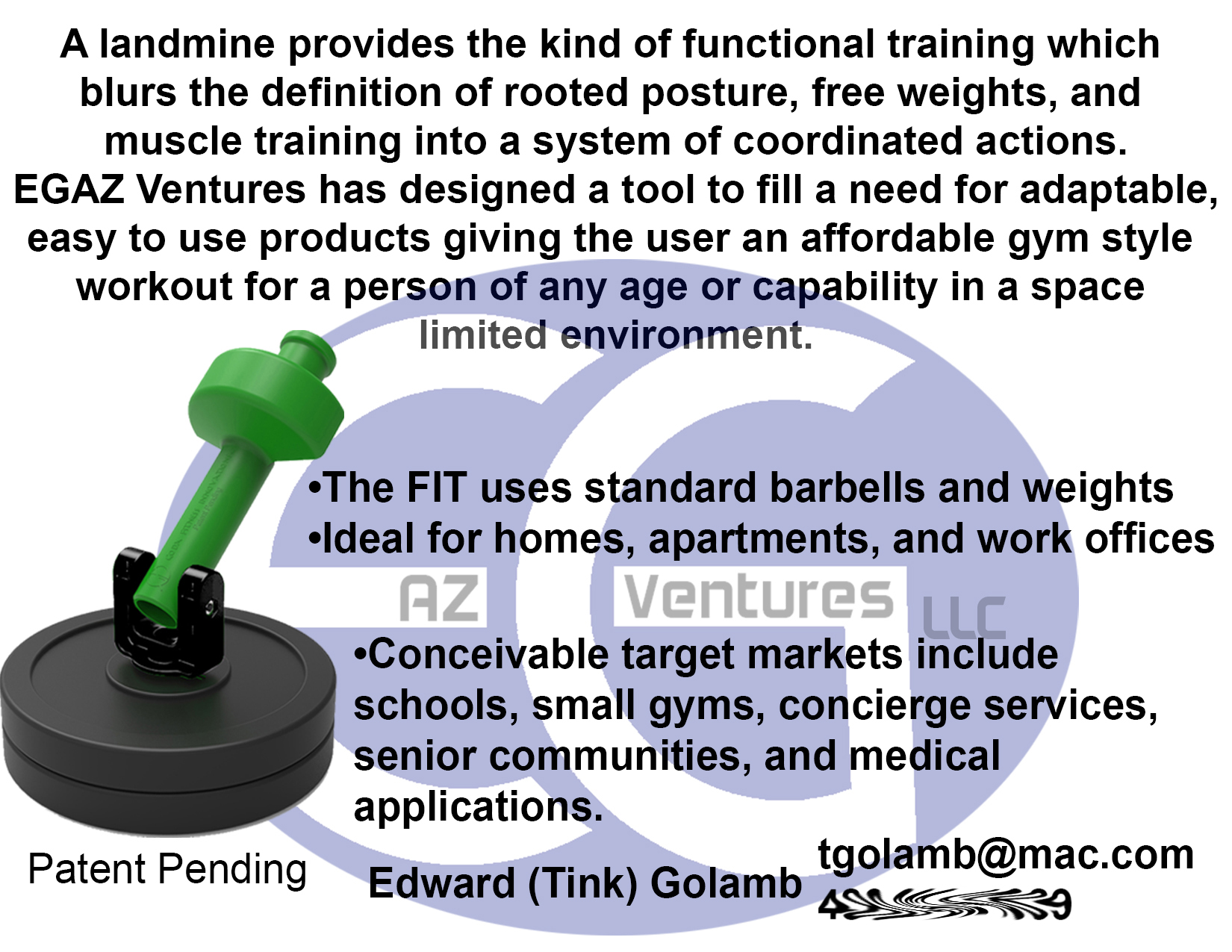
When I originally designed my fitness unit, none of the current covid situation was taking place. I just wanted to create an intuitive device that people could use at home. Now that we are in the position that we are, my unit makes working out and getting in shape at home all the more conceivable. I am looking for a licensee or potentially a licensing agent to help bring my invention to the people who want and need it.
My blog has evolved considerably since I first started it in 2004. I still attempt to update it with sometimes relevant and/or random observances as often as possible, but I can never promise which way the wind will blow on these things. Change is the only certainty.
Monday, August 17, 2020
Saturday, August 15, 2020
Plagued by nonsense
This is an unusual post, because I'm asking you to download a pdf, but I think it contains information to help you put the subject into perspective. It's worth your time to read it.
Right now, we are all confronting one of humanity’s scariest enemies: epidemic disease. Are we brave enough to face this horror? You bet we are! We’ve done it every day during the Covid-19 pandemic.
Covid is new. Other diseases have plagued our ancestors since ancient times. Mighty civilizations have been devastated by the invisible invaders we call “germs.” But people are not helpless! Over centuries, we learned how to fight back against disease. Our strongest weapons are science and critical thinking. However, germs have a powerful ally: misinformation! How do ignorance and bad ideas help the germs win—and what can we do about that? Let’s find out! In this free issue of Junior Skeptic we cover:
- Mindless Enemies
- Plagues of the Ancients
- Empires and Epidemics
- Scientific Facts about Bubonic Plague
- The Black Death
- Fighting the Plague
- Fighting Smallpox on American Soil
- The Spanish Flu
- Fighting Diseases Today
- Defeating Covid-19
Tuesday, August 11, 2020
Save Your Money: This Popular “Muscle Building” Supplement Is A Dud!
By Tom Venuto, from the “Burn The Fat, Feed the Muscle” e-zine
Did you ever wonder about amino acid supplements for building muscle? Many people do because you hear about them all the time. The reason you hear about this so often in bodybuilding and fitness is because amino acids are the building blocks of protein - including muscle protein.Out of the 20-some amino acids, 9 of them are called essential, because your body can't make them, and so you have to get them from your food (protein foods). Research has found that 3 of these essential amino acids are especially important for building muscle - leucine, isoleucine, and valine. These are known as the branched chain amino acids or BCAAs.
Out of these 3 BCAAs, research has discovered that leucine is especially important in the muscle building process. Some people even call leucine an "anabolic trigger." All of these are facts. BCAAs are important, and leucine is especially important.
For this reason, enterprising companies began selling BCAA supplements, and highlighting the leucine content, claiming that it would help increase muscle growth and or retain muscle better on calorie restricted diets. BCAA supplements were hugely popular and became a big moneymaker for the supplement companies.
Then research started saying that the evidence for taking isolated BCAAs was weak, and perhaps didn't do anything to increase muscle, only to shrink your wallet. How could this be so, if BCAAs really are so important in the muscle building process? The answer is simple: You already get BCAAs from the protein foods you eat!
If you get enough total protein every day, and you get it from high quality sources, you'll automatically get the BCAAs you require, without any need to spend extra money on BCAAs in supplemental form.
It's true, there are some studies showing that BCAAs play a role in preserving lean mass in a hypocaloric diet, increasing immune function, improving recovery, reducing soreness and promoting protein synthesis, and advocates continue to cite this information to promote BCAAs to this day.
Many of the older studies on BCAA were done on elderly and untrained subjects. In the most recent study, the case against BCAA / leucine supplementation was strengthened further and expanded to people who lift - in this case, young resistance trained males.
In this case, 25 trained subjects were consuming an adequate amount of protein - approximately 1.8g/kg per day. Half the subjects were randomly assigned to get 10 grams of free leucine or alanine. Note that 2 grams twice a day (10g) was considered a high dose of leucine, so if it were going to have any benefit, it should have shown up at that dose. Older studies may have been criticized for under-dosing.
After a 12-week lifting program, high-dose leucine did not enhance gains in muscle strength or muscle mass. The primary reason given was that adequate protein was already being consumed from the regular food in the diet, so all amino acid needs were already met.
This study adds to the growing body of evidence that supports the following conclusion: Don't waste your money on any BCAA supplements.
Apocalypse Never: Why Environmental Alarmism Hurts Us All
Michael Shellenberger has been fighting for a greener planet for decades. He helped save the world’s last unprotected redwoods. He co-created the predecessor to today’s Green New Deal. And he led a successful effort by climate scientists and activists to keep nuclear plants operating, preventing a spike of emissions. But in 2019, as some claimed “billions of people are going to die,” contributing to rising anxiety, including among adolescents, Shellenberger decided that, as a lifelong environmental activist, leading energy expert, and father of a teenage daughter, he needed to speak out to separate science from fiction. His conclusion: “Climate change is real but it’s not the end of the world. It is not even our most serious environmental problem.”
Despite decades of news media attention, many remain ignorant of basic facts. Carbon emissions peaked and have been declining in most developed nations for over a decade. Deaths from extreme weather, even in poor nations, declined 80 percent over the last four decades. And the risk of Earth warming to very high temperatures is increasingly unlikely thanks to slowing population growth and abundant natural gas. Curiously, the people who are the most alarmist about the problems also tend to oppose the obvious solutions. Shermer and Shellenberger also discuss:
- what’s really behind the rise of apocalyptic environmentalism,
- the powerful financial interests in environmentalism,
- the desire for status and power among environmentalists, along with the all-too human propensity to moralize and tell other people what to do,
- Shellenberger’s hypothesis that environmentalism is a faux religion primarily followed by secular people searching for transcendence,
- Environmental Humanism as a replacement worldview,
- the problems and shortcomings of climate computer models,
- how much warmer it’s going to get and what the consequences of that warming will be, and what we do about it? (hint: nuclear),
- myths about nuclear power and why people fear it,
- renewables, solar, wind, geothermal, and why they are not nearly as efficient as nuclear,
- the Amazon: Are the Earth’s lungs burning?
- plastic straws, recycling, electric cars, and other things,
- Are we in a Sixth Extinction?
- How have sweatshops saved the planet?
- How have technology and capitalism saved the whales?
- meat eating, Temple Grandin, and happy farms vs. factory farms,
- the myth of natural: what is natural is good, non-natural is bad,
- why environmentalism is the dominant secular religion of the educated, upper-middle-class elite in the most developed nations, with good guys and bad guys, heroes and villains, and
- Environmentalism as Calvinism — Richard Rhodes: “In the sense that the world is an evil place and it would be better if it were destroyed and turned back over to the natural kingdom.”
Michael Shellenberger is a Time magazine “Hero of the Environment”; the winner of the 2008 Green Book Award from the Stevens Institute of Technology’s Center for Science Writings; and an invited expert reviewer of the next Assessment Report for the Intergovernmental Panel on Climate Change (IPCC). He has written on energy and the environment for the New York Times, the Washington Post, the Wall Street Journal, Nature Energy, and other publications for two decades. He is the founder and president of Environmental Progress, an independent, nonpartisan research organization based in Berkeley, California.
Friday, August 07, 2020
Fat Man & Little Boy
On the 75th anniversary of nuclear weapons, Dr. Michael Shermer presents a moral case for their use in ending WWII and the deterrence of Great Power wars since, and a call to eventually eliminate them. This essay was excerpted, in part, from Michael Shermer‘s book, The Moral Arc, in the chapter on war.
Three quarters of a century ago this summer, nuclear weapons altered our civilization forever. On July 16 the Trinity plutonium bomb detonated with the energy equivalent of 22 kilotons (22,000 metric tons) of TNT, sending a mushroom cloud 39,000 feet into the atmosphere. The explosion left a crater 76 meters wide filled with radioactive glass called trinitite (melted quartz grained sand). It could be heard as far away as El Paso, Texas. On August 6 the Little Boy gun-type uranium-235 bomb exploded with an energy equivalent of 16–18 kilotons of TNT, flattening 69 percent of Hiroshima’s buildings and killing an estimated 80,000 people and injuring another 70,000. On August 9 the Fat Man plutonium implosion-type bomb with the energy equivalence of 19-23 kilotons of TNT leveled around 44 percent of Nagasaki, killing an estimated 35,000 to 40,000 people and severely wounding another 60,000.1
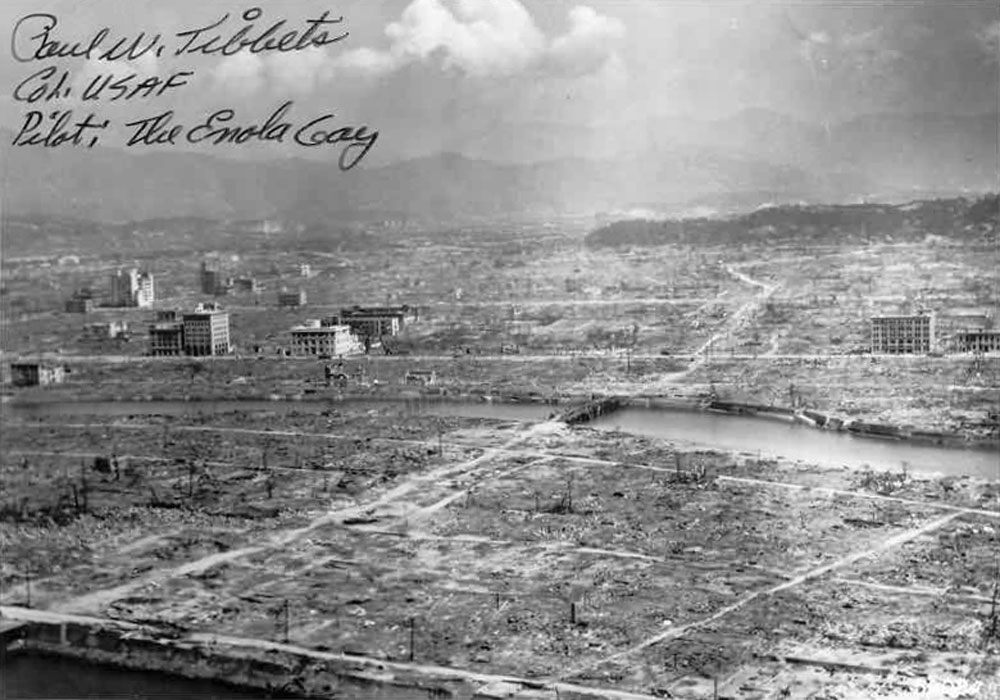
The aftermath of Little Boy
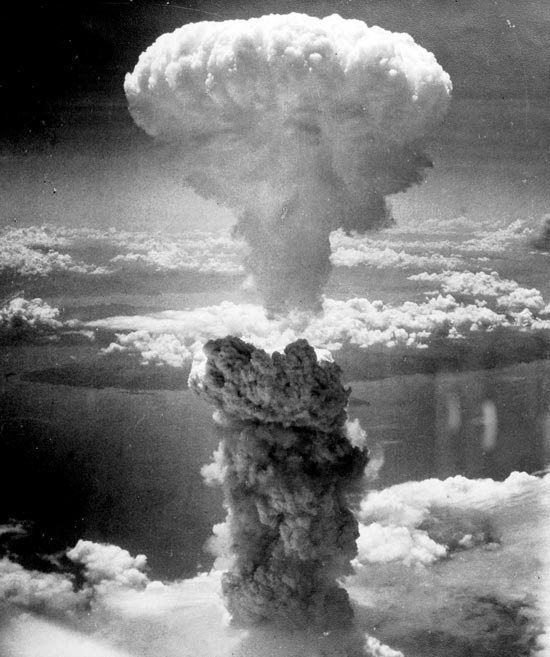
On August 9, 1945 the Fat Man plutonium implosion-type bomb with the energy equivalence of 19–23 kilotons of TNT leveled around 44 percent of Nagasaki, killing an estimated 35,000 to 40,000 people and severely wounding another 60,000.
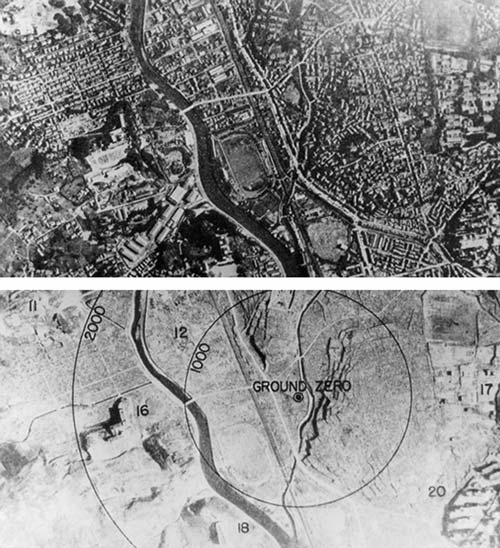
Before and aftermath of Nagasaki
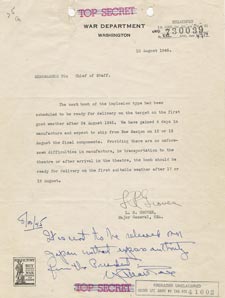
Click image to view larger PDF. Had the Japanese military hardliners had their way to continue the war into the fall, Groves had three more bombs readied for September and another three for October. Here he instructs his Chief of Staff that the next bomb will be ready to drop on after August 24. Emperor Hirohito capitulated on August 15, thereby saving millions of lives of his citizens.
As documented in the memo below dated August 10, 1945, if the Japanese had not surrendered the head of the Manhattan Project, Major General Leslie R. Groves, had another Fat Man-type plutonium implosion bomb ready to go after August 24 that would have likely killed another 50,000 to 100,000 people.2 And had the Japanese military hardliners had their way to continue the war into the fall, Groves had three more bombs readied for September and another three for October. President Harry Truman was not exaggerating when he threatened Japan with “a rain of ruin from the air, the like of which has never been seen on this Earth.” Truman did agonize about dropping more nukes on Japan, troubled as he was by the thought of more innocents and noncombatants being killed. He wrestled that decision away from the military. (Note Groves’ handwritten addendum to his memo that “It is not to be released on Japan without express authority from the President.” U.S. presidents have had sole authority to use nuclear weapons ever since.) However, further bombings proved unnecessary. On August 15 Emperor Hirohito, against the wishes of some of Japan’s military leaders, announced on the radio that Japan would capitulate. On September 2 they signed the surrender documents in Tokyo Bay, ending the Second World War.3
On this 75th anniversary of the summer of the bomb I want to make the case that their use was necessary to end the war, that their continued existence has acted as a deterrence against another Great Power war — but that we must eliminate them entirely for the long-term existence of our civilization and possibly our species. […]
Read the complete essay
Wednesday, August 05, 2020
Combatting Air Pollution’s Effects With Food
There is a food that offers the best of both worlds—significantly improving our ability to detox carcinogens like diesel fumes and decreasing inflammation in our airways—all while improving our respiratory defenses against infections.
Outdoor air pollution may be the 9th leading cause of death and disability in the world, responsible for millions of deaths from lung cancer, emphysema, heart disease, stroke, and respiratory infection. In the United States, living in a polluted city was associated with 16, 27, and 28% increases in total, cardiovascular, and lung cancer deaths, compared to living in a city with cleaner air. Also, living in a city with polluted air may lead to up to a 75% increase in the risk of a heart attack.
On top of that, the possibility of dying in a traffic jam is two and a half times greater in a polluted city. In addition to causing deaths, air pollution is also the cause of a number of health problems. It may not only make asthma worse, but also increase the risk of developing asthma in the first place. These pollutants may trigger liver disease and even increase the risk of diabetes. Indeed, even when atmospheric pollutants are within legally established limits, they can be harmful to health. So, what can we do about it?
Paper after paper have described all the terrible things air pollution can do to us, but most…failed to mention public policy. Therefore, while science is making great strides in demonstrating the harmful effects of atmospheric pollution on human health, public authorities are not using these data to reduce emissions. Such measures might inconvenience the population and, therefore, might not be politically acceptable. We need better vehicle inspections, efficient public transport, bus lanes, bicycle lanes, and even urban tolls to help clean up the air, but, while we’re waiting for all of that, is there anything we can do to protect ourselves?
As I discuss in my video Best Food to Counter the Effects of Air Pollution, our body naturally has detoxifying enzymes, not only in our liver, but also lining our airways. Studies show that people born with less effective detox enzymes have an exaggerated allergic response to diesel exhaust, suggesting that these enzymes actively combat the inflammation caused by pollutants in the air. A significant part of the population has these substandard forms of the enzyme, but, either way, what can we do to boost the activity of whichever detoxification enzymes we do have?
One of my previous videos Prolonged Liver Function Enhancement from Broccoli investigated how broccoli can dramatically boost the activity of the detox enzymes in our liver, but what about our lungs? Researchers fed some smokers a large stalk of broccoli every day for ten days to see if it would affect the level of inflammation within their bodies. Why smokers? Smoking is so inflammatory that you can have elevated C-reactive protein (CRP) levels for up to 30 years after quitting, and that inflammation can start almost immediately after you start smoking, so it’s critical to never start in the first place. If you do, though, you can cut your level of that inflammation biomarker CRP nearly in half after just ten days eating a lot of broccoli. Broccoli appears to cut inflammation in nonsmokers as well, which may explain in part why eating more than two cups of broccoli, cabbage, cauliflower, kale, or other cruciferous veggies a day is associated with a 20 percent reduced risk of dying, compared to eating a third of a cup a day or less.
What about air pollution? We know that the cruciferous compound is the most potent known inducer of our detox enzymes, so most of the research has been on its ability to fight cancer. But, for the first time, researchers tried to see if it could combat the pro-inflammatory impact of pollutants, such as diesel exhaust. They put some human lung lining cells in a petri dish, and the number of detox enzymes produced after dripping on some broccoli goodness skyrocketed. Yes, but we don’t inhale broccoli or snort it. We eat it. Can it still get into our lungs and help? Yes. After two days of broccoli sprout consumption, researchers took some cells out of the subjects’ noses and found up to 100 times more detox enzyme expression compared to eating a non-cruciferous vegetable, alfalfa sprouts.
Now, if only we could squirt some diesel exhaust up people’s noses. But wait, that’s just what some UCLA researchers did, at an amount equal to daily rush hour exposure on a Los Angeles freeway. Within six hours, the number of inflammatory cells in their nose shot up and continued to rise. But, in the group who had been getting a broccoli sprout extract, the inflammation went down and stayed down.
Since the dose in those studies is equivalent to the consumption of one or two cups of broccoli, their study “demonstrates the potential preventive and therapeutic potential of broccoli or broccoli sprouts,” but if broccoli is so powerful at suppressing this inflammatory immune response, might it interfere with normal immune function? After all, the battle with viruses like influenza can happen in the nose. What happens when some flu viruses are dripped into the nostrils of broccoli-sprout eaters compared with people consuming non-cruciferous alfalfa sprouts? After eating broccoli sprouts, we get the best of both worlds—less inflammation and an improved immune response. After eating a package of broccoli sprouts every day, however, our body is able to keep the virus in check, potentially offering “a safe, low-cost strategy for reducing influenza risk among smokers and other at-risk populations.”
So, better immune function, yet less inflammation, potentially reducing the impact of pollution on allergic disease and asthma, at least for an “enthusiastic broccoli consumer.” But what about cancer and detoxifying air pollutants throughout the rest of our body? We didn’t know, until now. Off to China, where levels of outdoor air pollution are among the highest in the world. By day one, those getting broccoli sprouts were able to get rid of 60 percent more benzene from their bodies. This was the key finding: the observed rapid and highly durable elevation of the detoxification of a known human carcinogen (benzene). Now, this was using broccoli sprouts, which are highly concentrated, equivalent to about five cups of broccoli a day, so we don’t know how well more modest doses would work. But if they do, eating broccoli could provide a frugal means to attenuate the long-term health risks of air pollution.
I’ve been reading about the terrible effects of air pollution for a long time and I am thrilled there’s something we can do other than uprooting our families and moving out to the countryside.
The Button: The New Nuclear Arms Race and Presidential Power from Truman to Trump
From authors William J. Perry, Secretary of Defense in the Clinton administration and Undersecretary of Defense for Research and Engineering in the Carter administration, and Tom Z. Collina, the Director of Policy at Ploughshares Fund, a global security foundation in Washington, DC, The Buttonrecounts the terrifying history of nuclear launch authority, from the faulty 46-cent microchip that nearly caused World War III to President Trump’s tweet about his “much bigger & more powerful” button. Perry and Collina share their firsthand experience on the front lines of the nation’s nuclear history and provide illuminating interviews with former President Bill Clinton, former Secretary of Defense Jim Mattis, Congressman Adam Smith, Nobel Peace Prize winner Beatrice Fihn, senior Obama administration officials, and many others. Shermer, Perry and Collina also discuss:
- even if Trump loses the 2020 election and we have President Biden, real risks of nuclear catastrophe exist because of the system, not the person,
- why the Iran deal was a good one to keep that country from developing nukes,
- how to deal with North Korea and Perry’s experience with the Kim dynasty,
- why the Russians are rational actors who do not want nuclear war,
- terrorists and the possibility of them getting a nuke,
- why we must eliminate Launch on Warning and First Strike policies,
- what is in “the football” seen held by men constantly trailing the President?
- Stanislav Petrov: the man who saved the world, and what this story tells us about the precariousness of our current system,
- game theory, the logic of deterrence, and how to get around it,
- why nuclear weapons were not inevitable, and
- changing the taboo from not using nuclear weapons to not owning them.
William J. Perry served as Undersecretary of Defense for Research and Engineering in the Carter administration, and then as Secretary of Defense in the Clinton administration, and has advised presidents all through the Obama administration. He oversaw the development of major nuclear weapons systems, such as the MX missile, the Trident submarine and the Stealth Bomber. His new “offset strategy” ushered in the age of stealth, smart weapons, GPS, and technologies that changed the face of modern warfare. His vision now, as founder of the William J. Perry Project, is a world free from nuclear weapons.
Tom Z. Collina is the Director of Policy at Ploughshares Fund, a global security foundation in Washington, DC. He has 30 years of nuclear weapons policy experience and has testified before the Senate Foreign Relations Committee and was closely involved with successful efforts to end U.S. nuclear testing in 1992, extend the Nuclear Non-Proliferation Treaty in 1995, ratify the New START Treaty in 2010, and enact the Iran nuclear deal in 2015. Collina has published hundreds of articles, op-eds, and reports and appears frequently in major media.
Tuesday, July 28, 2020
New Study: A Quarter of the Calories That Kids & Teens Eat Come From Added Sugars & Fat
A recent study of children and teens found that more than 25 percent of the calories they consume are considered “empty,” which are calories from added sugars and solid fats. The top sources of empty calories were soft drinks, fruit drinks, cookies, brownies, pizza and ice cream.
The study has not yet been published; but it was presented at the virtual American Society for Nutrition conference.
Using data spanning from 2007 to 2016, this research adds information on both sugar and fat intake trends among children and adolescents. That, in turn, can help inform new ways to promote healthier eating, said Edwina Wambogo, PhD, RD, lead author of the study and a recent postdoctoral Cancer Research Training Award Fellow with the National Cancer Institute.
“The more we understand children’s eating habits, the more of an impact we can make on this population in regards to overall nutrition, diet and lifestyle, as these components play a crucial role in [adult] cancer risk and prevention,” said Sheena P. Swanner, MS, RDN, AICR’s Director of Nutrition Programs.
Limiting consumption of sugary drinks and foods high in sugars and fats are among AICR’s Cancer Prevention Recommendations. Foods that are packed with sugars and fats have relatively high calories in each bite – called the calorie density of a food – that can eventually lead to weight gain. And children who are overweight are more likely to be overweight as adults.
Among adults, AICR research shows that overweight and obesity increases the risk of a dozen cancers. Aside from not smoking, staying a healthy weight is one of the most important steps adults can take to lower their cancer risk.
And the #1 Culprit is…In the study, researchers used data from the 2007-2008 through 2015-2016 National Health and Nutrition Examination Survey to analyze diet trends for children and teenagers ages 2-18.
Among all age groups, empty calories declined, regardless of energy intake. Despite this positive trend, all age groups consumed more than 25 percent of their caloric intake from empty calories and the percentage of empty calories increased with age.
Top food sources for these empty calories remained almost the same from 2007-2008 to 2015-2016. Among all ages, soft drinks held the top spot for empty calories throughout the years.
As age increased, the sources shifted from beverages such as fruit drinks and flavored milks to foods such as pizza, cookies and other sweet bakery products. For beverages, older children and teens tended to consume more calories from soft drinks rather than fruits drinks and flavored milks.
New Strategies Needed to Create A Shift Foods categorized as empty calories are calories that primarily contain fats and added sugars. Familiar examples of empty calorie foods are cookies, sugary sodas and donuts – sweet foods and beverages that contain relatively few nutrients and plenty of calories. Other foods that make the empty-calorie list include those high in whole milk, cream and fats, such as cheese and pizza.
Not all foods categorized as empty calories are a bad thing, experts note. For example, cheese is a nutrient dense food and milk is a good source of calcium. With some of these foods, the goal is to limit consumption.
Government dietary guidelines recommend that the day’s total calories consist of less than 10 percent from added sugars and less than 10 percent from saturated fats.
This will make room for all the needed nutrients within a healthy calorie limit.
Based on their findings, the researchers suggest several strategies that might be used to help children and teens consume healthier foods. These strategies include increased marketing that promotes healthier foods to children and teens along with limited marketing of less healthy foods, and nutrition education that addresses hidden sources of empty calories from frequently consumed foods. Changing the food environment to ensure availability of healthy foods and product reformulations are other suggested strategies.
Today, close to one in five kids and teens are obese.
“I encourage parents to start reading food labels and ingredients and understand what they mean,” says Swanner. Sodium, calories, fiber and added sugars are all areas to look at on a food label. “As parents (and children) recognize and become more aware of foods that they are eating that may not be as healthy, they can start choosing healthier alternatives and transition to an overall healthier diet which in turn can help shift to a healthier food landscape.”
They Are Already Here: UFO Culture and Why We See Saucers
More than half a century since Roswell, UFOs have been making headlines once again. On December 17, 2017, the New York Times ran a front-page story about an approximately five-year Pentagon program called the Advanced Aerospace Threat Identification Program. The article hinted, and its sources clearly said in subsequent television interviews, that some of the ships in question couldn’t be linked to any country. The implication, of course, was that they might be linked to other solar systems. The UFO community—those who had been thinking about, seeing, and analyzing supposed flying saucers (or triangles or chevrons) for years—was surprisingly skeptical of the revelation. Their incredulity and doubt rippled across the internet. Many of the people most invested in UFO reality weren’t really buying it. And as Scoles did her own digging, she ventured to dark, conspiracy-filled corners of the internet, to a former paranormal research center in Utah, and to the hallways of the Pentagon.
In They Are Already Here we meet the bigwigs, the scrappy upstarts, the field investigators, the rational people, and the unhinged kooks of this sprawling community. How do they interact with each other? How do they interact with “anomalous phenomena”? And how do they (as any group must) reflect the politics and culture of the larger world around them? Funny and colorful, and told in a way that doesn’t require one to believe, Scoles brings humanity to an often derided and misunderstood community. Scoles and Shermer discuss:
- who the “they” are in her title,
- comparing the UFO community to that of SETI scientists, whom she wrote about in her previous book, Making Contact: Jill Tarter and the Search for Extra-Terrestrial Intelligence?
- what it was like engaging UFOlogists at conferences,
- her answer to the Fermi paradox: where is everyone?
- what it means to “believe” in UFOs vs. ETIs,
- Project Saucer, Project Sign, Project Grudge, Project Bluebook,
- Robert Bigelow, Tom DeLonge, and the To the Stars Academy of Arts and Science,
- the most probable explanation for the USS Nimitz UFO videos,
- Kenneth Arnold, Roswell, Area 51, and modern myth making,
- Scoles’ Mormon background and how she lost her religion, and
- what we will replace religion with in the future.
Sarah Scoles is a science writer whose work has appeared in The Atlantic, Slate, Smithsonian, The Washington Post, Scientific American, Popular Science, Discover, New Scientist, Aeon, and Wired. A former editor at Astronomy magazine, Scoles worked at the National Radio Astronomy Observatory, the location of the first-ever SETI project. She lives in Denver, Colorado.
Tuesday, July 21, 2020
Healthy Summer Eating: The Problem With Auto-Pilot
Do visions of garden bounty make it seem like summer is when your eating habits are at their healthiest? Although eating habits in the summer may be different than in the winter, they’re not necessarily healthier.
The problem often comes from eating on “auto pilot” – turning to less healthful choices more often than we realize, and not taking advantage of opportunities for healthy choices nearly as often as we think.
The key point: there are ways to enjoy summer eating that are both healthy and delicious. However, we’re often on “auto-pilot,” making choices based on what’s promoted in commercials or what we remember from our childhood; a time well before we knew that day-to-day eating habits can reduce risk of cancer and other chronic diseases.
Its Grilling Season! Auto-pilot: “It’s all about the hamburgers, hot dogs, and sausage.”
Fresh perspective: Even if an occasional burger, hot dog, or grilled sausage is a highlight of the summer for you, strong evidence shows that processed meats like these raise your risk of colorectal cancer. Since its the fourth most common cancer in the U.S., it makes sense to choose other options for grilling.
Grill chicken and throw on a few extra pieces to give you quick-and-easy additions to sandwiches or salads over the next 3-4 days. For an extra-delicious touch, marinate the chicken for an hour or more ahead the herbs and seasonings of your choice.
Experiment with grilling fish or shellfish. For fun, explore options like grilling in foil packets and using a grilling basket. But no special equipment is needed, so have fun experimenting with grilling seafood.
Think outside the box for burgers. Turkey and salmon burgers are tasty, quick and delicious. Use traditional condiments, or expand your variety further with toppings like fresh tomato and fruit salsa, sliced avocado or grilled mushrooms. At the minimum, if you still go for beef, make sure you use a high quality, lean type of burger.
Savor the flavor of grilled vegetables, threaded into kebabs or marinated and tossed into a grilling basket. Round out the meal with choices that supply the protein you need. For example, include a salad with a hearty portion of black beans, garbanzo beans or lentils, or add a cheese and tomato appetizer or salad.
Instead of making hot dogs, sausage or burgers the focus of the meal, give them a smaller role and let a delicious vegetable or whole grain dish take center stage on your plate. Enjoying unprocessed red meat in kebabs mixed with peppers, zucchini, mushrooms or other vegetables makes it easier to keep with the recommended limit of no more than 12-18 ounces of cooked red meat per week.
Its Hot & We’re Thirsty! Auto-pilot: “Fill the cooler with soft drinks and beer and bring out the lemonade!”
Fresh perspective: As it heats up, drinking plenty of liquids doesn’t just help you feel more comfortable, it’s essential. But even though drinks may go down fast and easy, the consequences of your drink choice can stick around longer than you’d like. Each 16-oz sugar-sweetened glass of soda or lemonade gives you as much sugar as 12 large marshmallows! Also, drinks usually don’t satisfy your appetite as much as solid food.
This is not just a swimsuit-oriented concern. Excess body fat and adult weight gain increases the risk of at least 12 different cancers, as well as other chronic diseases like diabetes. The calories in a cooler full of beer are only part of the problem. Alcohol consumption, especially when its beyond the one to two a day limit of moderation, contributes to risk of at least six different cancers.
If making water your #1 beverage is a tough habit for you to establish, experiment with keeping a pitcher of water in the fridge with a tweak of flavor added. You could add a squirt of lemon or lime juice or infuse your water with any fruit of choice. You can get special “infusion pitchers” with a perforated core in the center to put your fruit in. No special equipment is actually needed though, just place some berries, peaches or apple slices, mint, cucumber or produce of choice in a pitcher or large bottle of water. After a few hours, natural flavors will transform the water from plain to flavorful.
Iced tea is a terrific summer cooler. If super-sweetened tea has been your go-to, don’t let tea’s health halo lead you to overlook the sugar content that’s comparable to regular soda. Gradually cut back on the sugar. Perhaps you’ll find this easier if you make home-brewed iced tea that combines regular black (or green) tea and a slightly fruity orange or other herbal or fruit tea.
No need to save iced coffee for a coffee shop treat. Brew some regular or decaf coffee to keep in a pitcher in the fridge and you can enjoy the treat at any time.
For a refreshing, bubbly drink, keep some club soda or seltzer in the fridge or cooler. Whether your preference is plain or flavored with unsweetened fruit essence, these can make a cool drink into an exploration of flavors.
We All Scream For Ice Cream! Auto-pilot: “Summer is the perfect time for ice cream. Go to the ice cream stand, eat a bowl at night in front of the TV, or enjoy a midday cool-off.”
Fresh perspective: Ice cream may seem like a natural part of summer for you, but the huge array of flavors to explore and widespread availability – with 24-hour delivery to your door in some areas – make it easy to go overboard. Further, what’s now considered a medium portion would once have been considered gigantic.
Reshape your bowl of ice cream. Start with a more sensible sized bowl of fruit and let a topping of a single scoop of ice cream drizzle the fruit with enticing flavor. Shift your focus to fruit as the essence of summer sweetness.
Ignore the coupons and 2-for-1 sales on ice cream gallons. Behavior science shows that when there’s more in the house, most people go through it faster. Despite what you tell yourself, if you’re an ice cream lover, stocking up will not last you extra-long.
At the local ice cream stand, bypass the portion distortion created by counting overflowing scoops. If going to the local ice cream stand is one of the joys of summer, choose the “kid-size” portion and slow down to savor the experience itself.
The Master Strategy: Identify your auto-pilot habits, think ahead about some alternatives that you would also enjoy and add them to a list in your phone or on your fridge. Train yourself to experiment with some of these other options and see which ones you might like to choose more often. With repetition, you can train yourself to make these your healthy auto-pilot choices.
Healthy summer eating doesn’t have to be about deprivation, but it shouldn’t compromise your health either. Consider rethinking the choices you’ve been making purely on auto-pilot. Select those choices that really do add to the flavors and energy of the season and try out some healthier options that may become your new summer habits.
False Alarm: How Climate Change Panic Costs Us Trillions, Hurts the Poor, and Fails to Fix the Planet
- How much warmer is it going to get?
- What will the consequences of the warming be?
- What should we do about it?
- How the public discussion/debate over climate has changed in the past 20 years since Lomborg wrote The Skeptical Environmentalist: Measuring the Real State of the World
- Precautionary Principle: should we do something “just in case”?
- What about other existential threats: AI apocalypse, nuclear weapons, pandemics? and
- Why climate is such a hard problem.
- we have a decade to solve the problem … or else
- droughts, floods, hurricanes, and extreme weather
- deforestation/reforestation
- polar bears/the 6th Extinction, and
- AOC/Greta Thunberg/Al Gore.
- individual action,
- why the Green Revolution isn’t here yet,
- why the Paris Agreement is failing,
- how climate policy hurts the poor, and
- reducing greenhouse gases.
- carbon tax: a market-based solution,
- innovation,
- adaptation,
- geoengineering, and
- prosperity.
Tuesday, July 14, 2020
Freedom from the Inside Out
The month of July hosts Independence Day celebrations around the world. July 1st was Canada’s Independence Day and the “4th of July” is recognized in the US as the day the states became free and independent from the tyranny of a foreign king.
The current global disruption is showing the world that freedom exists, or does not exist, on many levels. To speak without hindrance, to think and live without imprisonment has not been universally experienced and could be the subject of many blogs, but what we are writing about this week is your own inner freedom.
Freedom starts within yourself and your relationship with your own thoughts and internal conversations. You will never be truly free unless you are free from your own inner-tyranny and self-persecution.
In our education and training workshops, it surprises participants to learn that there are three roles that make up what we call the Dreaded Drama Triangle (DDT). There’s Victim, Persecutor, and Rescuer, and they all operate within our thought patterns and influence how we show up in our relationships in the outside world.
Many people do not realize their inner Persecutor, that self-critical, derogatory inner voice, can be running in the background of their consciousness, influencing their beliefs about themselves and the world. If your personal thoughts are self-critical, your peace of mind and emotional well-being will suffer, and you may never experience true personal freedom.
We have coached hundreds of leaders who, by all accounts, are outwardly successful, but when asked about what they say to themselves privately, they often are their own worst tyrants. Your relationship with yourself is the most important relationship you will ever have and how you relate to yourself will have a big impact on how you relate to others.
Victor Frankl, a survivor of Auschwitz and the holocaust, wrote in his classic book, “Man’s Search for Meaning”: “The last of human freedoms is the ability to choose one’s attitude in any given circumstances—to choose one’s own way.”
Fully embracing that you always have a choice is where personal freedom lives. The key to making empowered choices and personal freedom is to understand how your mind works. The more you understand that your inner Persecuting voice is actually only one of many voices, it will loosen its grip. Just because a thought pops into your head does not mean you have to believe it, give it any power, or act on it.
We all have self-critical and demeaning thoughts from time to time. The secret is to view them as passing chatter and just one of many thoughts you can focus on (but don’t have to). Just a few deep breaths or a short conscious walk can help you quiet the voice. Once you do this, you can calm yourself and ask yourself “How do I choose to respond?”
Personal freedom is choosing what thoughts to give your attention and power to. Just as you have the Dreaded Drama Triangle roles operating within you, you also have the empowerment roles of Creator, Challenger, and Coach available to consciously relate to yourself, others, and your life experience.
As you become more self-observant and aware, you can choose your response to life’s challenges. Taking responsibility for your choices will reinforce and grow your Creator essence and enable and empower you to act, to embrace the freedom to create your own life.
Your inner Creator helps to clear your mind and brings well-being and freedom to your life. You will feel a lot of more positive energy and joy when you see that freedom really does lies within. You may still hear your inner-tyrant (the Persecutor) from time-to-time, you just don’t have to give that voice any power.
You can choose personal freedom by understanding and cultivating the true essence of your inner Creator by simply asking yourself; “What kind of outcome would I see emerge this situation, what do I want to create here?”
Intimate Alien: The Hidden Story of the UFO
- What is religion and what role does it play in peoples’ lives?
- What is myth and what role does it play in peoples’ lives?
- what Carl Jung believed about UFOs and why,
- The Day the Earth Stood Still film as a Christ Allegory,
- why he’s an atheist but fascinated by the power of religion,
- why he’s a UFO skeptic but compelled by the power of alien beliefs,
- the origin of alien eyes,
- the origin of alien abductions,
- the true meaning of the Roswell incident,
- John Lennon’s UFO experience,
- Will religion fall into disuse with the rise of the nones?, and
- the future of religion in a post-COVID-19 world.
Tuesday, July 07, 2020
Enjoy the Health Benefits of Berries
July is National Berry Month! If berries aren’t part of your daily diet, now is the perfect time to start eating more of these fruits. Blackberries, blueberries, raspberries and strawberries are all great options that are bursting with antioxidants, vitamins, minerals and fiber, which help reduce risk of cancer and other chronic diseases.
It’s important to eat a variety of berries so you can reap the benefits of the different vitamins and minerals these fruits have to offer.
Blueberries are rich in antioxidants and protective plant compounds like anthocyanins and can help fight inflammation. They may improve brain, eye and heart health, and help to reduce cancer risk. The sweet taste of this berry makes it a nice addition to salads and smoothies.
Selection: Choose blueberries that are firm, plump and dry with a dusty blue color and are uniform in size. Avoid berries that are soft, shriveled or have any sign of mold.
Storage: Refrigerate blueberries for up to 10 days. Wait to wash until ready to eat.
Raspberries contain dietary fiber and polyphenols, which both play an important role in a cancer-protective diet. Did you know that 1 cup of raspberries contains 8g of fiber? AICR recommends eating at least 30g of dietary fiber per day as part of a healthy eating pattern to lower cancer risk.
Selection: Choose raspberries that are firm, plump and dry. Avoid wet or moldy berries.
Storage: Do not wash raspberries until ready to eat. Refrigerate for use within 1-2 days.
Blackberries are another great source of dietary fiber. One cup of blackberries contains 8g of fiber and these berries are high in vitamin C. You can pair blackberries with almonds or walnuts for an easy, high-fiber snack.
Selection: Choose blackberries that are shiny. Avoid blackberries that are bruised or leaking.
Storage: Refrigerate blackberries for 3-6 days. Wait to wash until ready to eat.
Strawberries are an excellent source of vitamin C and manganese and are rich in plant compounds, like polyphenols. Sweet, juicy and tart, these berries add a great flavor profile to any meal or snack.
Selection: Choose strawberries that are shiny and firm with a bright red color. Caps should be fresh, green and intact. Avoid shriveled, mushy or leaky strawberries.
Storage: Do not wash strawberries until ready to eat. Store in refrigerator for 1-3 days.
More tips for eating berries: Summer is a great time to add fresh berries into your daily diet, but keep in mind that frozen berries are available year-round and provide just as many health benefits. You can eat berries by themselves or add them to different meals and snacks. Below are a few easy ways to help you add more berries into your diet:
Add on top of cereal, oatmeal or yogurt
Toss into a salad
Throw a handful into a smoothie
Add to ice water for a naturally sweetened fruit infused water
Pharma: Greed, Lies, and the Poisoning of America
- how Big Pharma companies conspire to hack the FDA regulations,
- parsing responsibility for the Opioid crisis between manufacturers, distributors, doctors, and patients,
- the physiology of addiction and dependency,
- how Arthur Sackler went from liberal do-gooder to greedy capitalist,
- the polio vaccine and patenting the sun,
- how valium and anti-depressants were marketed to men and women differently,
- how the AIDS cocktail was developed,
- how Viagra® was discovered,
- why patents and intellectual property rights do not lead to more innovation,
- the prospects for a COVID-19 vaccine, and
- the current state of the opioid crisis and how to stem it.
